Crawl Space Vapor Barrier Encapsulation | Problems & Damage | About Crawl Spaces | Solutions & Benefits | Crawl Space Products | Spray Foam Insulation | SaniDry Dehumidifier | Sump Pump | Find a Local Expert | Contact
 

CRAWL SPACE SOLUTIONS and their BENEFITS

There is only one cause of all the problems in crawl spaces
— Relative Humidity.

 SO WHAT DO WE DO?

  • For the groundwater, install a sump pump system and make sure the water leaking in gets to it instead of ponding.
  • For the wet walls and exposed earth, install the patented CleanSpace crawl space.
  • For the open vents — close them — permanently with CleanSpace Vent Covers.

CLEANSPACE CRAWL SPACE ENCAPSULATION SYSTEM

The CleanSpace crawl space encapsulation system is a heavy duty 7-layer liner material; like a pool liner. It gets installed across the floor and up the walls and sealed around all piers and pipes, etc. It stops all the water vapor from the walls or soil and is very durable — so you can’t poke holes in it, rip it, or pull it down off the walls when you crawl in there — and yes, you’ll have no problem crawling into your crawl space once the CleanSpace liner is installed, it’s that clean, bright white, and nice! It will also last as long as the house. Besides that, it looks fantastic! Talk about a crawl space makeover!


A CleanSpace system turns your
crawl space into crawl space Heaven.
  CleanSpace is formulated with the Ultra-Fresh anti-microbial agent to resist mold and bacterial growth.

WHAT ABOUT THE VENTS?
Vents are sealed with vent covers installed outside. The building code required these vents when your home was built. The building code was wrong and made your problem worse by letting in hot, humid air in the summer, which causes condensation and rot and mold. In the winter these vents let in freezing cold air, making your floors upstairs cold and wasting energy. The building codes are now changing, and in the future vented dirt crawl spaces will be a thing of the past.
 
  Before: Open Vent   After: Sealed With Vent Cover  

SEAL ALL AIR LEAKS TO THE OUTSIDE

When a CleanSpace system is installed, you want to seal vents to keep out evil unconditioned outside air. But vents aren’t the only way outside air can get into your crawl space. Spaces under the sill plate and around pipes and wires to the outside, poorly fitting or rotted hatch doors, and other odd openings are all paths that need to be sealed to get the best results.

One area that was previously ignored is the open cavities in the top of block walls. Block walls are most common in dirt crawl spaces. Outside air goes right through porous block walls and up out of the top of the wall into the inside of the crawl space. To seal the top of the block walls, a product called "CleanSpace Wall Cap" works great. It’s an "L"-shaped molding that slips right on top of the block wall covering the space the sill plate does not. The clear plastic allows for termite inspections without removing it.

PROVIDE FOR PLUMBING LEAKS IN YOUR CRAWL SPACE

In a dirt crawl space a plumbing leak will leak into the dirt forever (because you’ll never notice it), keeping the dirt wet and the humidity up. When a CleanSpace system is installed, a plumbing leak can fill up your crawl space like a swimming pool. Sump systems like SuperSump and TripleSafe, have airtight lids with airtight floor drains that drain water from the top of the CleanSpace liner in the event of a plumbing leak in your crawl space.

If you don’t have groundwater leakage you won’t need a sump system in your crawl space with your CleanSpace system. However, you still need to provide for plumbing leaks. You can do this with a SmartDrain.

A SmartDrain is a drywell-type unit that gets installed in your crawl space along with the CleanSpace liner. It features an alarm and an airtight floor drain in its lid. In the event of a plumbing leak, the alarm sounds alerting you to the leak, and the water drains away into the soil under the CleanSpace until you get the leak fixed.

YOUR CRAWL SPACE ACCESS DOOR SHOULD SEAL TIGHT

Many crawl spaces have an access door to the outside. Most often it is made of plywood, and because it’s down by the ground it rots easily. These rotted warped doors usually seal poorly and look like heck. The answer is an all-plastic door — that won’t rot, warp, or need paint, and bugs won’t eat it. Perfect.

Knobs screw into anchors in the wall to draw the door tight against weather-stripping to seal off outside air.

 
  Before: A rotting, loose-fitting, warped plywood door lets in lots of air.   After: A snug-fitting, all-plastic door stops air and moisture from entering  

CRAWL SPACE INSULATION

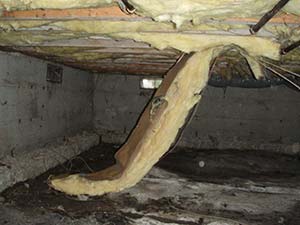
If you are going to insulate or reinsulate your crawl space, it’s better to insulate the walls with two-inch foam insulation than to stuff fiberglass between the floor joists. The foam insulation can be put on under or over the CleanSpace liner.

DEHUMIDIFYING YOUR CRAWL SPACE

Once a sump system and a CleanSpace liner are installed, and the vents are closed, the "cherry on top" is a dehumidification system. The SaniDry Basement Air System comes in a lower height unit for crawl spaces called SaniDry CSB.

Remember it’s not just the crawl space (or basement) you are dehumidifying. Because air rises from the bottom to top of your home, the air that now rises will dry your house instead of wetting it.

Another way to dry the air in your crawl space is to "condition" it. This means you use the Heating and Air Conditioning System to heat, cool, and dry the crawl space. Because your crawl space is low it doesn’t really tax your system very much at all. In fact, because warm air rises to heat the floors above, it costs almost nothing as long as you have a complete CleanSpace system installed and seal the vents and other air openings to the outside.

One way to condition a crawl space is to constantly blow a small amount of air from upstairs into the crawl space. You can do this with a "Crawl-O-Sphere air machine." Depending on the size of your crawl space, this system draws from between 15 and 80 cubic feet of air per minute from the upstairs and blows it into your crawl space. The air from upstairs is dry in the summer (if you have central air conditioning) and warm and dry in the winter, and for little cost, will dry your crawl space pretty well. It is not as effective as a SaniDry, but the Crawl-O-Sphere machine is a lower-cost alternative.


  SaniDry really dries out your crawl space.
SaniDry CSB's low profile, air filtration,
and heavy-duty drying make this the
perfect crawl space dehumidifier.
 

FIXING YOUR CRAWL SPACE PAYS FOR ITSELF

A vented dirt crawl space is a huge energy waster. The outside air constantly flowing into your home increases the heat and air conditioning load. And the dampness needs to be wrung out of the air by your air conditioning system, which puts a heavy tax on it — and you. It costs you real dollars in energy bills, not to mention the cost of wood replacement, mold clean-up, and property-value reduction.

find_expert_spin.gifAn independent study revealed that homeowners who properly fix their vented dirt crawl space can save 10% to 20% on their heating and air conditioning costs! If the conditions are right (meaning all wrong before the installation), you can save more than that. CleanSpace is one of those things that you are going to pay for whether you get it or not. That makes it a no-brainer to get it.


home | problems & damage | solutions & benefits | products
find a local expert | contact | become a listed expert

Copyright ©   Crawl Space Maintenance | All Rights Reserved.

Crawl Space Maintenance

Verbage, images and videos on Crawlspacemaintenance.com are for general informational purposes only. Crawlspacemaintenance.com and its affiliates are not responsible for the pricing, quality or installation of good and services. Visitors agree to hold both Crawlspacemaintenance.com and its affiliates harmless for any related damages in doing business or inquiring to do business with the experts contacted in all circumstances.

E-mail: info@crawlspacemaintenance.com  

web site design by jhWebWorks